Conventional Scottish pipe chanters have a nine-note diatonic scale. This is true for all the main types: the Great Highland Bagpipes and their various smaller derivatives, the Border Pipes and the Scottish Smallpipes. There are thousands of good pipe tunes using just these nine notes, and many great composers and pipers who’ve remained eternally satisfied with that limitation. So why do some of us want more, and isn’t that a bit arrogant for those (like me) who’ve not even got full control over what’s there?
Well, it’s not quite that simple! Border Pipes have historically been able to get some extra range by overblowing, with a (natural?) capacity to produce chromatic notes through additional forked fingerings developed and refined by modern makers. Some accidentals can also be produced on the GHB (Great Highland Bagpipes), and some of our very greatest recent pipers (e.g. Gordon Duncan) have exploited their possibilities. Some Border Pipes (like my Garvie set) have keys for extended range in lieu of the reed compromises necessary to get the same notes by overblowing, and some SSPs (Scottish Smallpipes) also have keys for extended range and/or accidentals. To which it might not be too much of a digression to add that modern Irish Uilleann Pipes and Northumbrian Smallpipes have also evolved considerably from their respective ancestors in terms of range, keys etc.
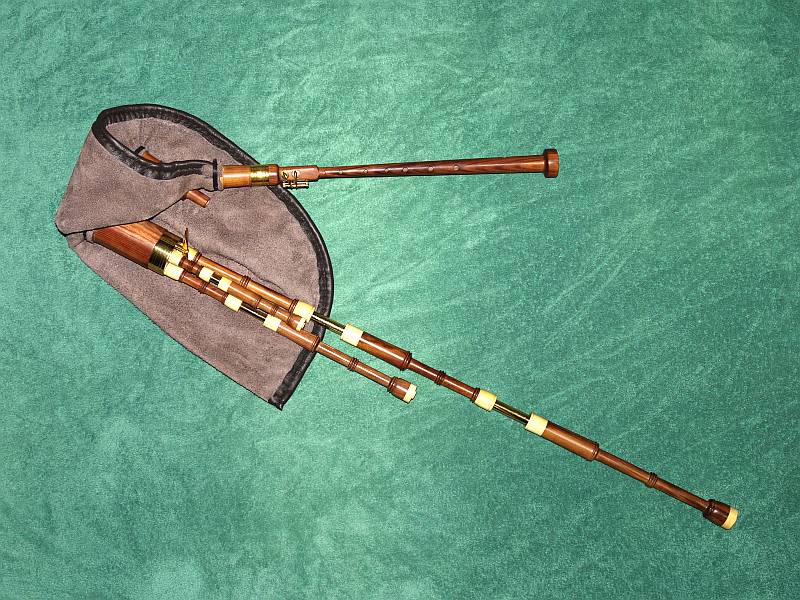
Now the nine-note chanter is standard in Scottish piping and (quite properly!) likely to remain so. Nobody’s trying to replace it, but some of us are naturally excited about complementing it. While there are many great native (nine-note) tunes for it, some of us just wince at the number of octave-folded or chromatically-altered notes spoiling imported parts of its repertoire, some have come to the pipes from other instruments with more notes, and some are simply inspired by the creative possibilities of Scottish pipes with extended range and/or chromatic capabilities! Some, like the hugely-talented Callum Armstrong in collaboration with pipe maker Julian Goodacre, are doing really exciting things with double and triple SSP chanters, extended-range, overblowing, keyed SSP chanters and even rapidly-tunable/switchable drones. Others, like Donald Lindsay, have approached the challenge from different angles, with Donald’s Lindsay System Chanter utilising clever design to be a 3D-printable (as well as conventionally-buildable) keyless two-octave instrument with some chromatic capability. And Donald’s system, for its very simplicity and reproducibility, is the one I see as a potential ‘standard’ for the typical player (like me) itching to get their hands on a set of extended-capability SSPs.
A few years back Donald ran a very successful Kickstarter campaign to launch the original run of Lindsay System Chanters, but development continues and now he’s hoping to record an album at Watercolour Music featuring the instrument in stimulating group contexts with a starry list of collaborators. So he’s back to Kickstarter and looking for backing at MakerSpace : Donald WG Lindsay & Friends : Album. I’ve committed to the price of a chanter (which will need further adaptation for my missing finger if I want the low D, which of course I do!), but you can pledge as much or as little as you like… ‘rewards’ range from keyrings to multi-packs of albums and chanters, but for me the real reward would be in helping Donald bring this very special chanter design to the prominence it so richly deserves. He’s also running a competition for new tunes for it with the winner to be included on the album, but I’m rather looking forward to being able to try my entry on my own Lindsay System Chanter! So I’m inspired, and perhaps this wee blog piece might help to inspire others? I hope so because this campaign needs support with just 21 days to go and this chanter really is the greatest thing since sliced bread (in SSP terms anyway)!